
What Old Town Christmas Says About the Leander That's Still Becoming |
As Leander prepares for its December 5 Christmas festival, Maggie Jo Callahan and Willa Travis find a larger question beneath the lights: how does a fast-growing Texas city hold on to the things that make it home? |
The old railroad photograph had been sitting on Willa Travis's table all afternoon.
Maggie Jo Callahan leaned closer to study it.
"Well, now. That's a Leander you don't see every day."
"No," Willa said. "And that's why I like keeping the picture around."
The photograph showed the town's earlier railroad-era character, before Leander became a growing northern neighbor of Austin and a familiar stop on the commuter rail line.
"People talk about how fast this place is growing," Willa continued. "Sometimes I think they forget that Leander was here long before all these new neighborhoods."
Maggie Jo smiled.
"That happens to a lot of places. Folks get so interested in where a town is going that they stop asking where it came from."
"And we're going somewhere, all right."
"I've heard that."
Willa laughed.
"The railroad built Leander. The MetroRail rebuilt it. At least that's one way I think about the story."
Maggie Jo glanced back at the photograph.
"Two very different chapters, both connected by the tracks."
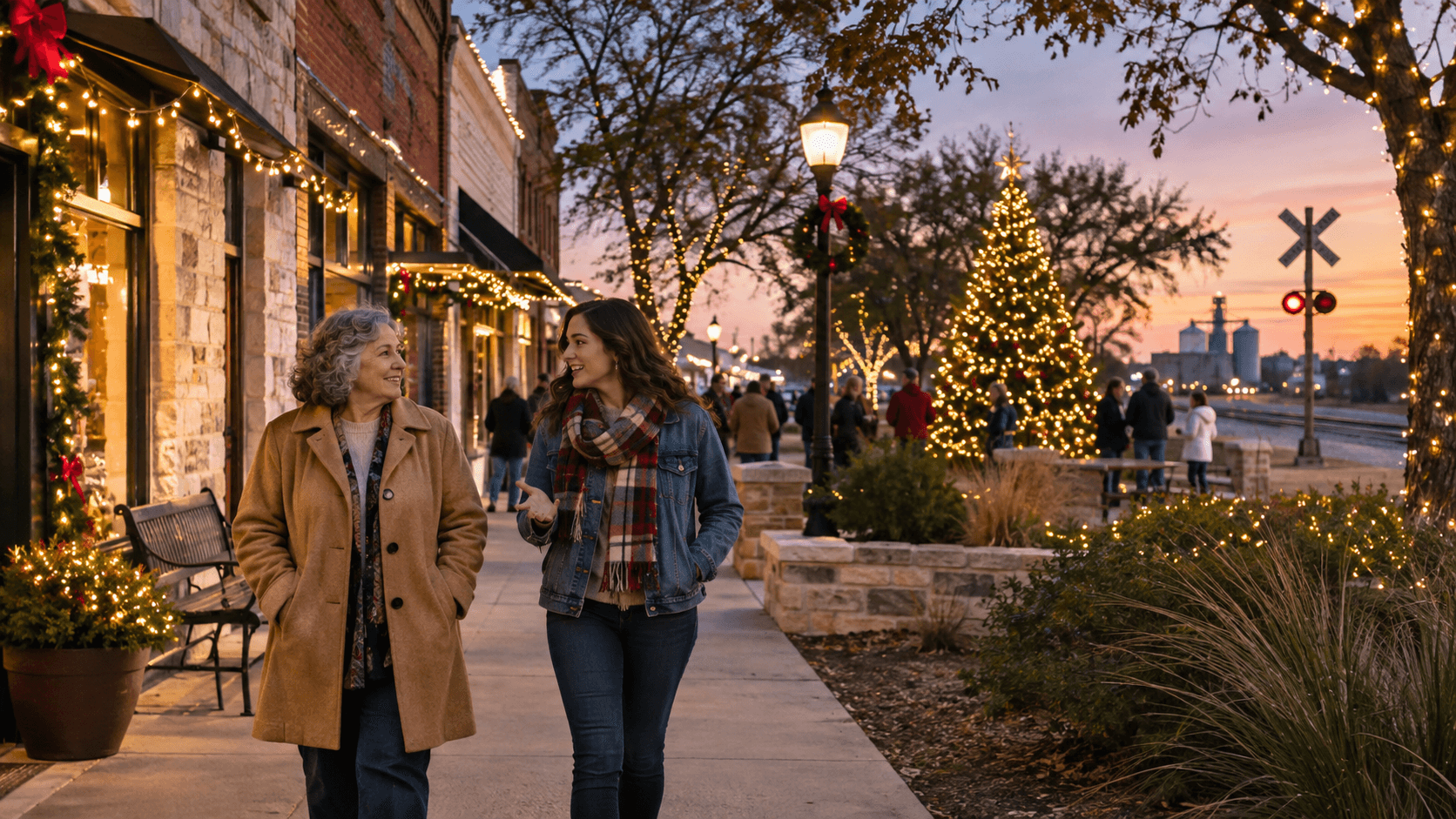
"And now we're getting ready for Christmas in Old Town, which is a fine place to see how those chapters fit together."
The Old Town Behind the New City
Leander traces its founding to 1882, when the railroad created a new community along its route. The city's official historical account identifies the railroad as central to that beginning.
Today, Leander is a much larger city, with transportation, housing, parks and other community infrastructure changing alongside its population.
Maggie Jo placed the photograph carefully on the table.
"Now, Willa, I come from a part of Texas where people spend quite a bit of time talking about preserving the old ways."
"And I appreciate that," Willa replied. "But Leander has a slightly different challenge."
"Tell me about it."
"We can't pretend we're still a little railroad town. Too many families live here for that. Our schools, roads, parks and neighborhoods have real needs."
"So you aren't trying to turn back the clock."
"No. I want us to remember the clock has been running for a long time."
Maggie Jo considered that.
"That's a better distinction than some people make. Preservation isn't necessarily asking a town to stop growing."
"Right. It means keeping something recognizable while the next part of the city takes shape."
"And Old Town is part of that."
"Yes. When people come for Christmas, they're visiting a place that belongs to Leander's earlier story. That matters to me."
Christmas Has a Way of Gathering a Town
Willa turned to the festival announcement.
"Saturday, December fifth. Old Town Christmas."
Maggie Jo read the schedule.
"A morning run, a marketplace, an afternoon parade and a tree lighting in the evening. That's a full day."
"It is. And this year's theme is Rudolph the Red-Nosed Reindeer."
"Now, there's a Christmas story that's been following families around for generations."
Willa smiled.
"It's familiar. That's part of the fun."
The 2026 Old Town Christmas Festival will bring community organizations, local vendors, performers and families into the historic district. The City of Leander and the Leander Chamber of Commerce organize the annual celebration.
"What interests me," Maggie Jo said, "is how many different people have a reason to take part."
"That's what I see, too," Willa replied. "You've got families coming for the parade, people who want to look through the market, runners getting an early start, and neighbors who show up for the tree lighting."
"And those people might not ordinarily end up in the same place on a Saturday."
"Not in a city this spread out."
Maggie Jo nodded.
"Shared traditions. There's something to be said for them."
Willa leaned back.
"Especially when your neighbors have arrived at different times. Some families remember when Leander was much smaller. Others have moved here in the last few years. They don't all have the same history with the city."
"But they can begin making one together."
"Exactly."
A Railroad Town With a Commuter's Calendar
Maggie Jo looked out the window.
"Here's the thing I notice when I come through this part of Williamson County. People are always on their way somewhere."
"You noticed that, did you?"
"I certainly did."
Willa laughed.
"That's life in Leander for a lot of people. They work in different parts of the Austin area. Their children have school activities. They try to make room for the parks and trails. And plenty of households are still getting settled."
"Then an afternoon in Old Town is a chance to spend time somewhere without rushing to the next errand."
"That's what I hope people get from it."
Maggie Jo smiled.
"Take a deep breath and stay a while. That's generally my advice."
"Mine might be a little more energetic," Willa admitted. "I love seeing how much this city is doing. But I agree that families need places where they can slow down together."
"There's room for both ways of looking at it."
"That's why I like this conversation."
The two women studied the festival schedule for another moment.
"Leander is still becoming," Willa said. "And that's the most interesting thing about it."
Maggie Jo nodded.
"Provided there's still a place to sit down and remember what came before."
"Oh, there will be. If I have anything to say about it."
Why Local Traditions Need Local People
The Christmas parade is scheduled for 1 p.m., with participating community groups, businesses and city representatives expected along the route near Old Town.
For visitors, the parade offers something cheerful to watch. But its meaning for Leander depends on people putting in time before the first float begins moving.
Maggie Jo tapped the announcement.
"That's one part of town celebrations I've always appreciated. People see the finished parade, but there's a great deal of work they don't see."
"Right," Willa answered. "Decorations have to be prepared, community groups have to organize, and the city has to make the event safe for families."
"And shopkeepers have to be ready for company."
"That too. Old Town businesses and market vendors are part of the day. If people come out and spend time there, they're supporting an active neighborhood, not just looking at Christmas decorations."
Maggie Jo looked pleased.
"That's what keeps a tradition from becoming nothing but a picture of the past."
"Exactly. Old Town can't survive on nostalgia alone. It needs people who use it, businesses that can operate there, and neighbors who want to come back."
"And a reason for the next generation to care."
Willa nodded.
"That's the part I think about. A child who remembers the Old Town parade this year might grow up with a completely different Leander from the one we know today."
"But that child might still recognize Christmas in Old Town."
"That's the hope."
A Place Between the Hills and the City
Maggie Jo picked up her coat.
"You know, Willa, there's something fitting about having this conversation here. Leander sits near the edge of the Hill Country, but it has its own way of looking toward Austin."
"We've never been exactly one thing," Willa said.
"Nor should you have to be."
Willa folded the festival announcement and placed it beside the photograph.
"People sometimes think the interesting part of Leander is how quickly everything is changing. And that is interesting. But I don't want growth to be our whole identity."
"What would you rather people remember?"
Willa considered the question.
"The families who made a home here. The people who built the community when it was smaller. The neighbors working now to make sure the city grows well."
"And the Christmas celebrations?"
"Those too. They're one of the ways people get to know the place they've chosen."
Maggie Jo smiled.
"Well, that's a fine answer."
"Not bad for a city that's still figuring itself out."
Maggie Jo looked once more at the railroad photograph.
"Perhaps figuring itself out is what every good town keeps doing. The trick is making sure the people who love it have a hand in the answer."
Willa reached for the photograph.
"That's exactly what I want for Leander."
Outside, another ordinary evening was settling over Williamson County.
Old Town's Christmas celebration was still ahead.
But the story it was helping tell had begun many years before, with a railroad, a small settlement and the people who decided to call it home.
Old Town Christmas 2026: Quick Facts
Event Information Note: The festival's 2026 date, schedule, theme and main activities were reviewed against City of Leander and Leander Chamber sources on November 19, 2026. Confirm current parade arrangements, closures, parking and weather updates with the organizers before attending.
Editorial Note: This is a fictional Hill Country Shoutouts editorial conversation featuring Maggie Jo Callahan and Willa Travis. Their meeting, dialogue, setting and personal reflections are imagined, not a recorded interview or firsthand account. The historical and event information is drawn from the sources listed below.
Sources and Further Reading
|
0 Comments
Join the conversation
Be the first to comment
Share your thoughts above.